Communication & Events 8 min read
Producing an event of honour: what gets decided before the first guest arrives
A banquet, an awards ceremony, a corporate celebration: what people see lasts a few hours, what holds it up is decided over three months. The reverse schedule, the floor plan, production management and the table, by the people who build them.
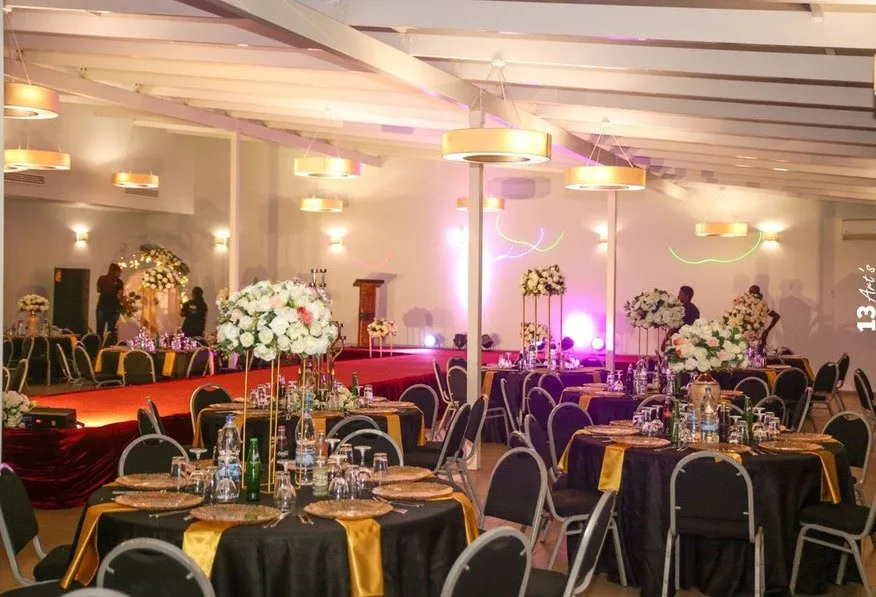
A successful evening goes unnoticed. Nobody says of an event that it was well produced: they say the room was beautiful, that they could hear properly, that the service was quick. Those are three technical judgements dressed up as compliments — and each of them is settled several weeks before the doors open.
Here is what we decide, and when, on an event of honour: a banquet, an awards ceremony, an anniversary celebration, an institutional launch. The method is the same at fifty covers as at five hundred; only the margins change.
The schedule is counted backwards
You do not start from the order date, you start from the date of the event and work back. Every item has a lead time that cannot be compressed, and it is the longest one that sets the day production has to begin.
- D‑90 — the frame. Date, venue, capacity, nature of the event, overall budget. Nothing else. A venue is booked before it is decorated.
- D‑75 — the identity. Name, theme, colours, poster, applications. This is what locks everything else down: you do not print an invitation before the logotype is settled.
- D‑60 — invitations and the partner pack. Printing requires a press proof, and a press proof requires proofreading. Allow for the back-and-forth; there always is some.
- D‑45 — the technical work. Site survey, floor plan, lighting plan, load calculation, safety plan. This is the moment you discover the room has only two usable power sockets.
- D‑30 — confirmations. Chasing guests, settling the protocol, fixing the order of speakers.
- D‑10 — closing the covers. The figure that drives the caterer’s purchasing, the number of chairs and the seating plan. After that date, every addition is paid for at a premium.
- D‑1 — build and rehearsal. Structures, furniture, sound, lighting, mic checks, a dry run of the schedule with the master of ceremonies.
- D+1 — strike and inventory. It is part of the quotation. A supplier who does not price the take-down has not planned for it.
This calendar is not decoration: it is the first deliverable we hand over, and the only document that lets a client know, week by week, whether the event is ahead of schedule or behind.
The floor plan is a technical document
A seating plan is an exercise in diplomacy. A floor plan is something else: a dimensioned drawing that answers physical constraints.
The service aisles govern everything. Table service assumes staff can reach every guest without passing behind an occupied chair. So the circulation is drawn first, the tables second — never the other way round. A plan drawn in the wrong order is paid for in minutes of service, and minutes of service show: the last table served is the one that remembers.
The rostrum is placed according to light and cabling, not symmetry. It has to be visible from every table, reachable without crossing the dance floor, and connected without a cable crossing a walkway.
Production management needs to see the stage. Putting the sound desk at the end of a corridor amounts to asking the engineer to mix what they cannot hear.
We allow for buffer places. There are always unannounced arrivals. A reserve of a few covers and one complete table costs less than a table improvised in the middle of an aisle.
Production management: what must never be heard
Everyone hires equipment. What separates production management that is held from production management that is endured comes down to three points.
The load calculation, before the generator. You add up the loads — sound, lighting, kitchen, refrigeration, screens — apply a margin, and that total is what chooses the generator. A generator sized by guesswork collapses the moment the lighting goes to full load, which is to say during the speeches.
Redundancy on anything you cannot recover from. A spare wireless microphone, paired and tested, sitting next to the lectern. A backup power supply on the desk. A set of fresh batteries at the control position. That is a few thousand francs protecting the one moment when the whole room is listening.
The checks, at staff mealtime. Sound checks are done before the caterer comes into the room, not during. A mic check run 30 minutes before doors on the day is not a check, it is a gamble.
When an evening starts in daylight and ends after dark, you also need a written lighting plan: the circuits, the loads and the time of each changeover. The transition has to be slow enough that nobody notices it — which requires, precisely, that it was written down.
Protocol is timed, not improvised
At an event of honour, the spoken word is the heart of the arrangement. It is also what overruns the most.
The order of speakers is settled in advance, along with the time allotted to each and the exact names of the people cited — spelling and title included. The master of ceremonies works from a written, timed running order, with the prompts planned in. The welcome desk holds the seating list and knows who is expected at which table.
Two simple rules head off most of the slippage: no address exceeds the time announced, and thanks are given once. Protocol that is held frees up time for what the guests came for — the table, the music, the conversation.
When the audience is bilingual, interpreting is planned on the same footing as sound: whispered interpreting for a top table, a booth and headsets for a full audience. You do not plug in headsets the night before.
The table says the same thing as the theme
The menu is not a separate line item, it is the extension of the argument. Three points come up at every banquet we produce.
Quantities are calculated on confirmed covers, never on invitations sent. The gap between the two is the first source of waste, in both directions: too much and food is thrown away; too little and you come up short in front of witnesses.
Mechoui and long cooking are prepared upstream, not in the kitchen. They require a dedicated area, a cooking time that cannot be compressed, and carving performed in front of the guests. That is what makes it a moment rather than a dish.
The cold chain and the pace of service are costed. The number of waiting staff follows from the number of covers and the number of aisles, not from habit. A badly paced buffet creates a queue; a queue puts the room on its feet, and a room on its feet has stopped listening.
What happens when things go wrong
A serious production plan has a “what if” column. In Abidjan, it comes down to four lines: rain, power, a speaker running late, capacity exceeded.
Rain is handled by a fallback decided at D‑45, not on the day: tarpaulins, a backup marquee, or a move indoors with a second floor plan already drawn. Power is handled by the generator and its redundancy. Lateness is handled by a running order built from interchangeable blocks. Capacity is handled by the reserve of covers.
None of those four lines is expensive in advance. All of them are expensive on the day.
A worked example: the Banquet de Lyli
We apply this method to an event we produce in full, and which is also our own initiative: the Banquet de Lyli, first edition on 29 August 2026 at the Sweet Garden in Bonoumin, on the theme “L’Échappée Belle”. Doors in broad daylight at 3 p.m., a turn towards gold in the late afternoon, lanterns after dark; three movements — opening ceremony, tributes, banquet and artistic programme; mechoui and table service.
It is the best place to judge our work: an event where we have nobody else to pass responsibility to. The theme and its running order are told in detail in the article devoted to it.
What we take on
Event design and production, logistics management — marquees, staging, sound, screens, lighting, generators, furniture — welcome staff and hostesses, catering and table service, translation and interpreting, signage and printed material produced in our own workshop. One quotation, one named contact, one invoice.
The first document we hand over remains the reverse schedule. If the date is already fixed, write and tell us: it is the date that will say whether the calendar holds.
Related division Communication & Events
A need on this subject?
Describe it in three lines. We come back to you with precise questions, then a quote.
Also worth reading
- Communication & Events L’Échappée Belle: what the table of the Banquet de Lyli is saying The theme of the first edition is a tribute. Here is where it comes from, how it reads in the run of the evening, and why it is played out on the plate as well. Read the article
- Printing & Production The press proof, or how not to pay for the same print run twice A file left in RGB, a missing bleed, a font that was never outlined: three ordinary mistakes that are always discovered after printing. The document that protects both parties fits on one page. Read the article