Building & Civil Works 5 min read
A borehole is not judged on the day it is handed over
On the day it is commissioned, every borehole works. What separates them shows up two seasons later: the wellhead, the seal, and maintenance the users can actually carry out.
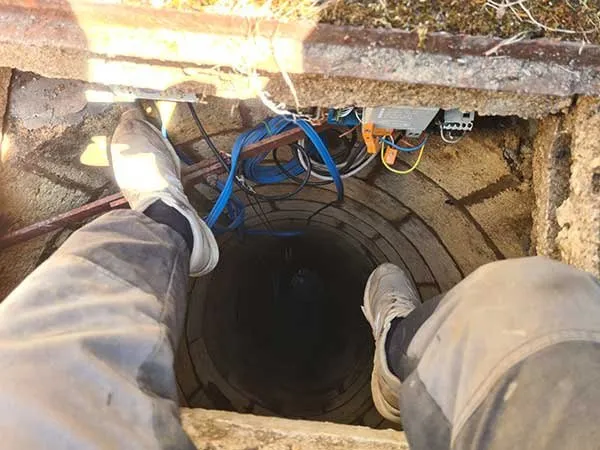
On handover day, every borehole gives water. That is precisely why it is handed over. The trouble is that this particular day proves almost nothing: the water table is high, the pump is new, the slab is dry and nobody has opened the control box yet.
What separates a structure that lasts from one that will fail shows up two seasons later. Better to discuss it beforehand.
The wellhead, or where the water gets dirty
Contamination in a borehole almost never comes from the bottom. It comes from the top: run-off seeping down along the casing, a cracked apron, a slab that sends water back towards the structure instead of away from it, a lid that does not close properly.
A proper wellhead is three simple things — and three things that get dropped when someone wants to bring a quotation down:
- a grout seal cemented over the full height of the weathered zone, which stops surface water travelling down along the casing;
- a reinforced concrete apron that extends generously around the casing, with a slope that takes water away, not a flat surface that holds it;
- a sealed closure at the head, bolted down rather than merely laid on top.
On a quotation, those three lines cost little. Removed, they are invisible at handover. They become visible at the first bacteriological analysis, or at the first rainy-season outbreak in the neighbourhood.
The pumping test is not a formality
A serious pumping test runs for hours and is read off a table: you pump in steps, record the drawdown, and watch the level recover after stopping. What you are looking for is not the maximum yield — it is the operating yield, the one the structure can deliver every day without running itself dry.
A borehole equipped beyond its operating yield works perfectly through the rainy season, then loses suction in February. The pump gets the blame, the pump gets replaced, and the problem returns the following year: it was never the pump.
The rising main and the control box, where breakdowns actually happen
Most of the call-outs we are asked to handle on existing structures concern neither the borehole nor the pump, but what sits between the two:
- couplings that were never labelled, and have to be dismantled blind;
- a rising main whose immersion depth nobody wrote down — so it cannot be lifted without pulling everything out;
- a control box with no dry-running protection, which lets the pump turn empty until it burns out;
- no sampling tap at the head, which forces you to open the structure to run an analysis — and to contaminate it in the process.
None of these points is expensive to install. All of them become expensive later.
Maintenance has to be sustainable for the people who stay
This is the point most often overlooked, and it is the one that decides the real service life of the structure. A maintenance plan that assumes a specialist technician and an imported spare part will not be followed. So it has to come down to a few actions, within reach of the users or a local tradesperson:
- a visual check of the apron and the closure, after every heavy rainfall;
- a monthly meter reading — consumption climbing for no reason points to a leak or a pump wearing out;
- an annual measurement of the static water level, recorded in a notebook kept on site;
- a water analysis at least once a year, taken from the tap at the head.
We leave that notebook and those instructions when the structure is handed over, along with the as-built file: drawings matching what was actually built, the pump data sheet, the recorded depths. They remain yours — including if you entrust maintenance to someone else.
What we price
Abstraction structure, grout seal and sealed head, pumping equipment and rising main, apron and superstructure, pumping test and commissioning. The schedule of prices is itemised line by line: you can compare it, take a line out, or phase the works — none of which a lump-sum price allows.
Related division Building & Civil Works
A need on this subject?
Describe it in three lines. We come back to you with precise questions, then a quote.
Also worth reading
- Communication & Events Producing an event of honour: what gets decided before the first guest arrives A banquet, an awards ceremony, a corporate celebration: what people see lasts a few hours, what holds it up is decided over three months. The reverse schedule, the floor plan, production management and the table, by the people who build them. Read the article
- Communication & Events L’Échappée Belle: what the table of the Banquet de Lyli is saying The theme of the first edition is a tribute. Here is where it comes from, how it reads in the run of the evening, and why it is played out on the plate as well. Read the article